원문 자료실 / 제조·공급망
차세대 물리적 자율 시스템
Next Generation Physical Autonomy
- 발행기관
- World Economic Forum
- 발행일
- 2026.04 · PDF 표지의 발행 연월 기준
- 원문 언어
- 영어
- 분량
- 13쪽 · 1.9MB
- 본문 검색
- 원문 텍스트 검색 가능
원본 파일의 내용은 수정하지 않았습니다.
이 원문을 활용한 발행물
원문과 검색 정보
한국어 제목과 주제 분류는 탐색을 돕는 편집 정보입니다. 수치·주장은 PDF의 해당 페이지를 기준으로 확인하세요. 본문은 PDF의 텍스트를 추출했으며, 도표·이미지의 의미는 별도 검토가 필요합니다.
추출한 원문 앞부분 보기
Global Future Council on Autonomous Systems

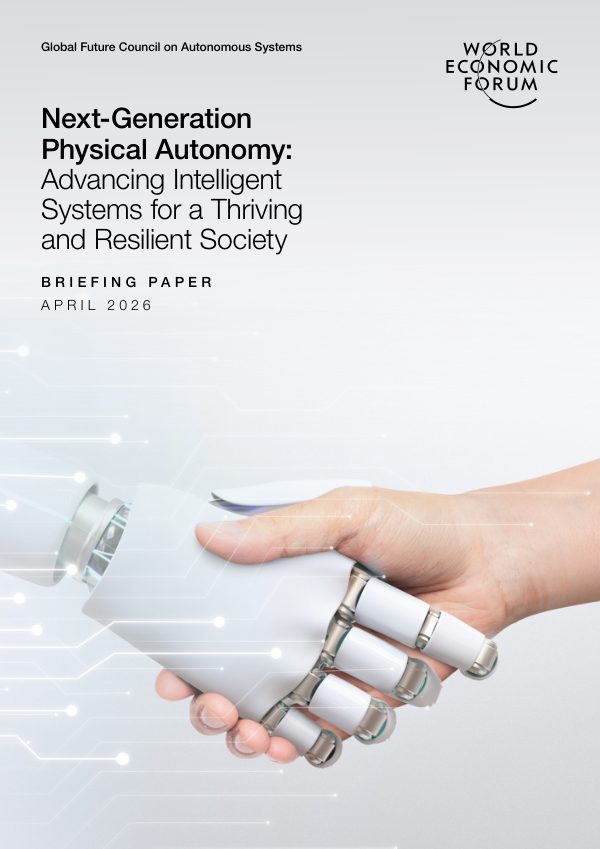
Next-Generation
Physical Autonomy:
Advancing Intelligent
Systems for a Thriving
and Resilient Society

B R I E F I N G P A P E R
A P R I L  2 0 2 6

Images: Getty Images

Contents


Introduction                                                    3

Key trends shaping the future of physical autonomous systems            5

Four scenarios for physical autonomous systems by 2031                7

Strategic objectives for long-term resilience                          10

Accelerating collective action                                     11

Contributors                                                  12


Disclaimer
This document is published by the
World Economic Forum as a contribution
to a project, insight area or interaction.
The findings, interpretations and
conclusions expressed herein are a result
of a collaborative process facilitated and
endorsed by the World Economic Forum
but whose results do not necessarily
represent the views of the World Economic
Forum, nor the entirety of its Members,
Partners or other stakeholders.
© 2026 World Economic Forum. All rights
reserved. No part of this publication may
be reproduced or transmitted in any form
or by any means, including photocopying
and recording, or by any information
storage and retrieval system.


                Next-Generation Physical Autonomy: Advancing Intelligent Systems for a Thriving and Resilient Society   2

April 2026    Next-Generation Physical Autonomy:
             Advancing Intelligent Systems for a Thriving and Resilient Society


   Introduction


          Autonomous robots are no longer confined to        Robots have reached a technological inflection
             factory floors. They are entering daily life – driving       point just as demographic, economic and
          on public roads, delivering goods, assisting in          environmental pressures intensify. As physical
             healthcare, supporting facilities management and     autonomous systems move into shared
            operating in hazardous environments.                 environments, they will reshape how societies
                                                                                       live and work. Their trajectory will be shaped by
             Physical autonomous systems integrate artificial         technological, economic, societal and geopolitical
              intelligence (AI), information processing, sensing and     forces, and should be guided by design principles
            electro-mechanical capability to perceive, decide         tha
문서 식별번호 6ca8d52a436bde1b71bd4b7f · 페이지별 원문 API